Unity in Diversity: India's Strength, Culture & Unity
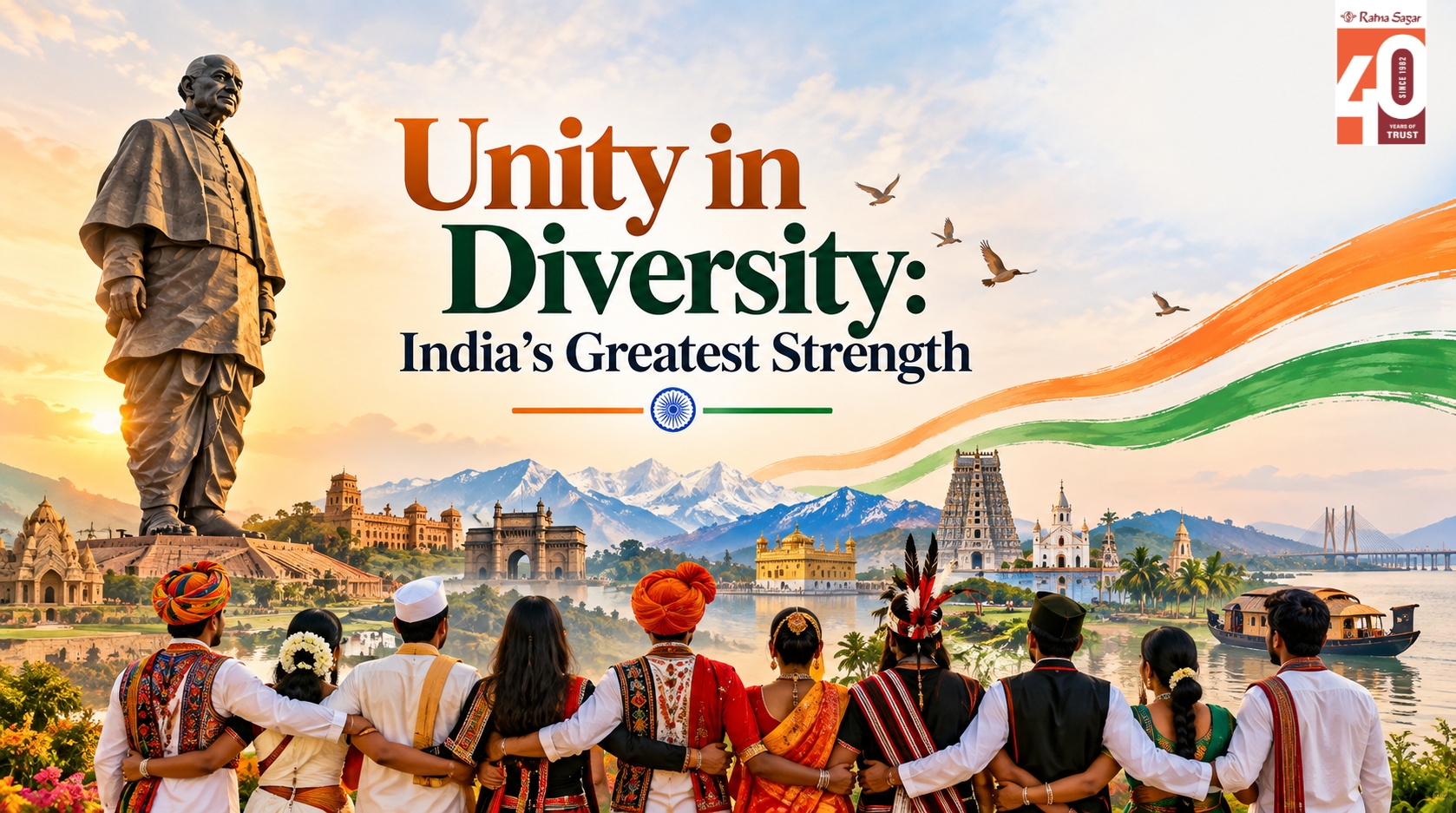
Unity in Diversity: India's Greatest Strength
Board a train in India and you will hear a dozen languages before the journey ends. One compartment shares parathas, another passes around idlis, and a third offers sweets from a festival that began the day before. Strangers become companions, and differences become conversation. This everyday scene captures what makes India remarkable: millions of people, vastly different from one another, living together as one nation.
This blog explores what "unity in diversity" means, how India has held it together, and how each of us can help keep it strong.
What Does Unity in Diversity Mean?
Unity in diversity means that people can differ in language, religion, food, dress, and customs and still stand together with shared values and a shared sense of belonging. It does not ask anyone to become the same. It asks us to respect one another's differences and to recognise what we hold in common.
India is perhaps the clearest example of this idea in practice. The Constitution recognises 22 languages in its Eighth Schedule, and hundreds more are spoken across the country. Hinduism, Islam, Christianity, Sikhism, Buddhism, Jainism, Zoroastrianism, and many other faiths and traditions have flourished here. Yet the people of the Himalayas, the deserts, the coasts, and the northeast all call themselves Indian.
The Many Faces of Our Diversity
Languages and literature. From Kashmiri to Malayalam and from Assamese to Gujarati, each language carries its own poetry, proverbs, and stories. Translation and shared reading allow these voices to reach one another.
Festivals. Diwali, Eid, Christmas, Baisakhi, Onam, Pongal, Bihu, Gurpurab, and Buddha Purnima fill the calendar. Many are enjoyed across communities. Neighbours share sweets, visit one another's homes, and join in the celebration regardless of faith.
Food and clothing. A single country offers dosas, dhoklas, litti chokha, momos, biryani, and rasgullas. Sarees, dhotis, salwar kameez, and traditional northeastern attire reflect the land and climate of each region.
Art, music, and dance. Bharatanatyam, Kathak, Odissi, Kuchipudi, Manipuri, and Bhangra sit alongside folk traditions and classical music styles such as Hindustani and Carnatic. Each has deep regional roots, yet all are celebrated as national treasures.
Roots of Unity in Indian History
The idea of unity amid variety is not new. Ancient texts spoke of the world as one family, a thought captured in the phrase Vasudhaiva Kutumbakam. Emperor Ashoka's edicts promoted tolerance and respect among different sects. In the medieval period, the Bhakti and Sufi movements crossed lines of religion and caste, spreading messages of love and equality through poetry and song. Kabir, Guru Nanak, and Amir Khusrau are remembered by people of many faiths.
During the freedom struggle, Indians from every region and background came together against colonial rule. Farmers, students, workers, women, and leaders of all communities joined the movement. Independence was won through shared purpose, not sameness.
Sardar Patel and the Making of a United India
When India became independent in 1947, it included more than 560 princely states that could choose their future. Sardar Vallabhbhai Patel, India's first Deputy Prime Minister and Home Minister, played a leading role in persuading most of them to join the Indian Union. His skill in negotiation earned him the title "Iron Man of India."
He was born on 31 October 1875, and his birth anniversary is observed as National Unity Day (Rashtriya Ekta Diwas). The government of India began observing it in 2014. On this day, the country pledges to protect the unity and integrity of the nation, and events such as the "Run for Unity" are held across cities. The Statue of Unity in Gujarat, one of the tallest statues in the world, stands as a tribute to his contribution.
10 Lines and a Short Essay on National Unity Day
Students and teachers often look for 10 lines and a short essay on National Unity Day for school assignments, speeches, and assembly talks. Here is a ready reference.
10 Lines on National Unity Day
National Unity Day is observed every year on 31 October.
It marks the birth anniversary of Sardar Vallabhbhai Patel.
Sardar Patel was born in 1875 in Nadiad, Gujarat.
He is called the "Iron Man of India."
He helped unite more than 560 princely states into the Indian Union.
The Government of India began observing the day in 2014.
The Statue of Unity in Gujarat honours his memory.
"Run for Unity" events are held across the country.
People take a pledge to preserve the unity and integrity of India.
The day reminds us that our strength lies in standing together.
Short Essay on National Unity Day
National Unity Day is celebrated on 31 October to honour Sardar Vallabhbhai Patel, who worked tirelessly to bring the princely states together after independence. His wisdom and determination helped shape India into a single nation. On this day, schools and offices hold pledges, speeches, and runs to spread the message of unity. India is home to many languages, religions, and cultures, and this variety is its true beauty. But diversity can only be a strength when people respect one another. National Unity Day reminds us to treat every citizen with kindness, to avoid prejudice, and to work together for the progress of our country.
Challenges to Unity
Unity is not automatic. It has to be protected. Prejudice based on religion, caste, language, region, or appearance can divide communities. Rumours and hateful messages spread quickly online and can turn neighbours into strangers. Inequality in opportunity can also leave some groups feeling excluded.
The Constitution offers strong safeguards. It guarantees equality before the law, freedom of religion, and protection of minority cultures and languages. It also lists fundamental duties, including the responsibility to promote harmony and brotherhood among all Indians. But laws work best when supported by everyday habits of respect.
How We Can Strengthen Unity
Unity is built through small, consistent actions:
At school: Befriend classmates from different backgrounds, and learn a few words from a language you do not speak.
At home: Teach children to respect all faiths and to treat every person with dignity.
In the neighbourhood: Join in one another's celebrations and help people in need, whatever their background.
Online: Verify before sharing, and never forward content that insults or targets a community.
In your thinking: Replace stereotypes with curiosity. Ask questions, listen, and learn.
Conclusion
India's strength has never come from being uniform. It comes from the ability of many voices to sing in harmony. Like a garland made of different flowers, each adds its own colour and fragrance, and the whole is more beautiful for it.
This National Unity Day, let us go beyond slogans and runs. Learn about a culture other than your own, reach out to someone different from you, and stand up when others are treated unfairly. That is the surest way to honour Sardar Patel's dream of a united India.
Explore more on the Ratna Sagar Blog: Independence Day, Gandhi Jayanti, and Ambedkar Jayanti.
Recent Posts
Unity in Diversity: India's Strength, Culture & Unity
03/11/2026
The Night Sky for Kids | Class 1 English Animated Story
26/10/2026
My Family Animated Story for Kids | Ratna Sagar
22/10/2026
Dussehra Across India: Traditions, Stories & 10 Lines and a Short Essay on Dusshera
15/10/2026
Did Mani Take a Bath? | Personal Hygiene for Kids
15/10/2026
Planning a Picnic: Class 1 English Learning
13/10/2026
International Day of the Girl Child: 10 Lines & Essay
09/10/2026Recommended Books