Gandhi Jayanti: Truth, Non-Violence and Its Relevance Today
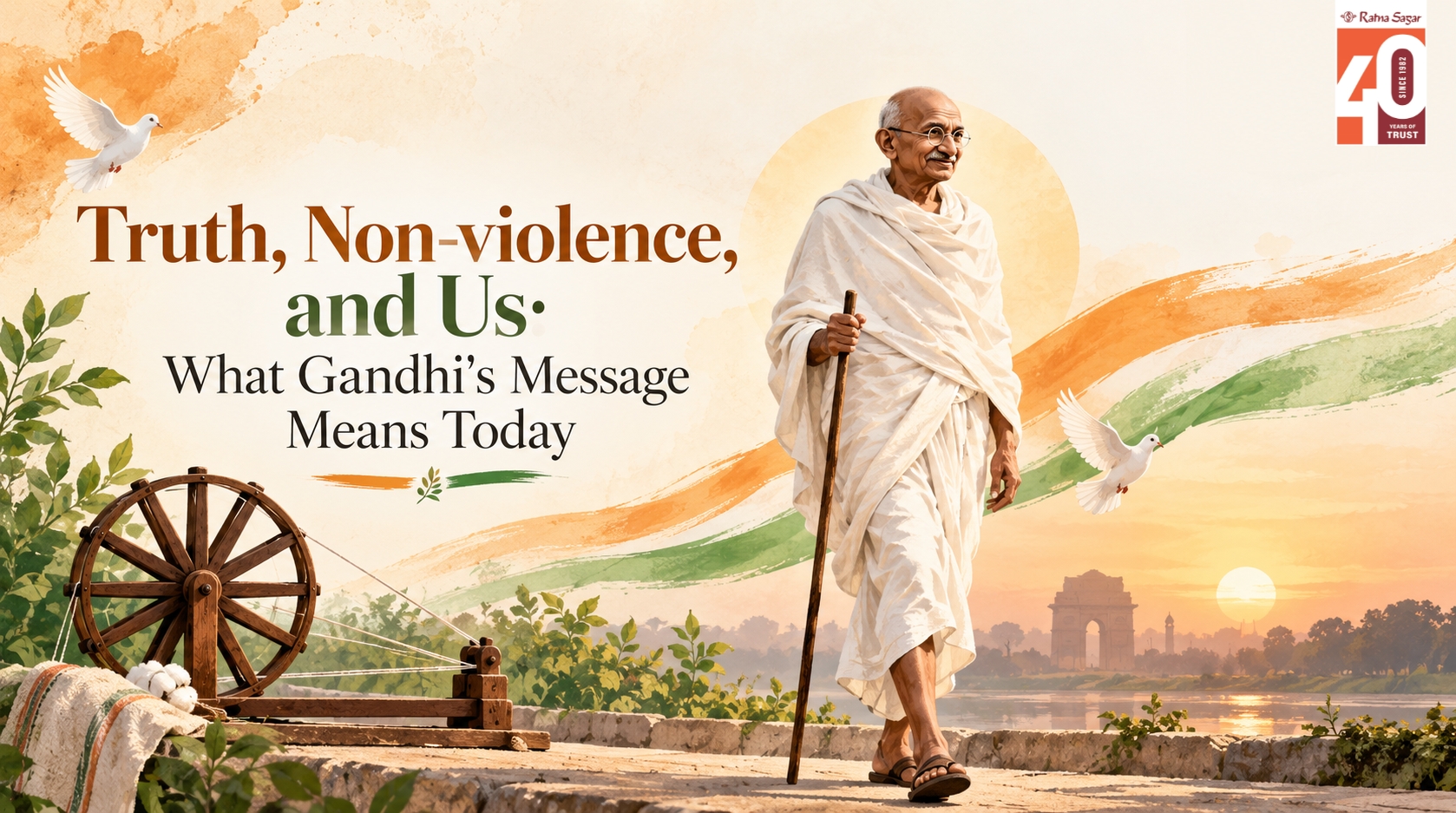
Truth, Non-violence and Us: What Gandhi's Message Means Today
Every year on 2 October, schools across India hold assemblies, students deliver speeches and classrooms fill with posters of a spectacled man in a simple dhoti. Gandhi Jayanti is one of the most widely observed days in the national calendar. But the day is meant to be more than a ritual. It asks us to look at the ideas that shaped Mohandas Karamchand Gandhi's life and to ask whether we are living by them.
Two ideas stand at the centre of his philosophy: satya (truth) and ahimsa (non-violence). More than a century after he began applying them, they remain remarkably relevant.
Who Was Gandhi? A Quick Recap
Gandhi was born on 2 October 1869 in Porbandar, Gujarat. He trained as a lawyer in London and travelled to South Africa in 1893, where he faced racial discrimination first-hand. It was there that he developed satyagraha, a method of resisting injustice through truth and peaceful action rather than force.
After returning to India in 1915, he led movements such as the Champaran Satyagraha, the Non-Cooperation Movement, the Dandi Salt March and the Quit India Movement. Ordinary people, including farmers, students and women, joined him in large numbers. He was assassinated on 30 January 1948, but his ideas have outlived him.
Truth: More Than Not Telling Lies
For Gandhi, truth was not limited to avoiding lies. It meant harmony between what we think, what we say and what we do. He went so far as to say that truth was God and he titled his autobiography The Story of My Experiments with Truth. In it, he openly described his own mistakes, which is itself a lesson in honesty.
Today, we live in an age of forwarded messages, edited photographs and viral rumours. Falsehoods can travel around the world before facts have put on their shoes. Gandhi's insistence on truth gives us a simple habit worth practising: pause and verify before you believe or share. It also asks for honesty in smaller matters, such as admitting a mistake in class, giving credit to a classmate, or being truthful with parents even when the truth is uncomfortable.
Non-violence: Strength, Not Weakness
Many people mistake non-violence for passivity. Gandhi saw it as the opposite, a demanding form of courage. He believed that refusing to hurt others, even while standing firmly against injustice, took far more strength than retaliation.
Non-violence also goes beyond physical harm. It includes the words we use, the jokes we make at someone's expense and the way we behave online. Bullying in school corridors, cruel comments on social media and exclusion of a classmate are all forms of violence that Gandhi's principle asks us to reject.
His approach also worked. The Salt March of 1930 saw thousands walk roughly 240 miles to Dandi to defy an unjust salt law, without a single weapon. It captured the world's attention and shook the foundations of colonial rule.
10 Lines and a Short Essay on Gandhi Jayanti
Students and teachers often look for 10 lines and a short essay on Gandhi Jayanti for school assignments, speeches and assembly talks. Here is a ready reference.
10 Lines on Gandhi Jayanti
Gandhi Jayanti is celebrated every year on 2 October.
It marks the birth anniversary of Mahatma Gandhi, born in 1869 in Porbandar, Gujarat.
He is lovingly called Bapu and is regarded as the Father of the Nation.
Gandhi led India's freedom struggle through truth and non-violence.
His major movements included Champaran, Non-Cooperation, the Dandi March and Quit India.
His autobiography is titled The Story of My Experiments with Truth.
He believed in simple living and promoted khadi and self-reliance.
2 October is a national holiday in India.
The United Nations observes it as the International Day of Non-Violence.
On this day, people offer tributes at Raj Ghat, hold prayer meetings and take part in cleanliness drives.
Short Essay on Gandhi Jayanti
Gandhi Jayanti honours the birth of Mahatma Gandhi, the leader who taught the world that change can come without violence. Born in 1869, he led India to independence using truth, peaceful protest and unity among people of all communities. He lived simply, spun his own cloth and believed that service to others was the highest duty. On Gandhi Jayanti, schools and offices hold prayer meetings, speeches and cleanliness drives. The day reminds us that real tribute lies not in garlands but in following his values of honesty, kindness and respect for all.
Applying Gandhi's Message in Everyday Life
The good news is that these ideas do not require a national movement. They can begin with small, daily choices.
At school: Speak up politely when someone is being teased and refuse to join in gossip or bullying.
At home: Resolve disagreements by listening first. Gandhi's method was always to understand the other side, not to defeat it.
Online: Think before you post. If a message would hurt someone in person, it will hurt them on a screen too.
In society: Keep public spaces clean, respect people from different backgrounds and use your voice for causes you believe in, peacefully and truthfully.
In yourself: Practise self-discipline and honesty about your own shortcomings, as Gandhi did.
Why It Matters Now
The world today faces conflict between nations, polarised debates and a constant flow of anger online. Gandhi's answer was neither naive nor outdated. He argued that means and ends are inseparable: a good goal cannot be reached through harmful methods without damaging the goal itself. That idea speaks directly to how we handle arguments, disagreements and competition.
His influence has also travelled well beyond India. Martin Luther King Jr. and Nelson Mandela both drew inspiration from his methods, which shows that these principles work across time and geography.
Conclusion
Gandhi Jayanti is a good moment to move from remembering Gandhi to learning from him. Truth asks us to be honest with others and ourselves. Non-violence asks us to be strong enough to be gentle. Neither is easy, but both begin with small choices made every day. This 2 October, beyond giving a speech or writing an essay, we might commit to one concrete act, such as telling the truth when it is hard, resolving a quarrel peacefully, or helping someone in need. That would be a fitting tribute to Bapu.
Recent Posts

Dussehra Across India: Traditions, Stories & 10 Lines and a Short Essay on Dusshera
15/10/2026
Did Mani Take a Bath? | Personal Hygiene for Kids
15/10/2026
Planning a Picnic: Class 1 English Learning
13/10/2026
International Day of the Girl Child: 10 Lines & Essay
09/10/2026
R K Narayan Birth Anniversary: Malgudi, Books & Legacy
06/10/2026
Gandhi Jayanti: Truth, Non-Violence and Its Relevance Today
01/10/2026
Earth and Its Shapes: Facts for Kids | Classes 2–4
24/09/2026Recommended Books