Birth Anniversary of Mahadevi Verma: 10 Lines & Short Essay for Students
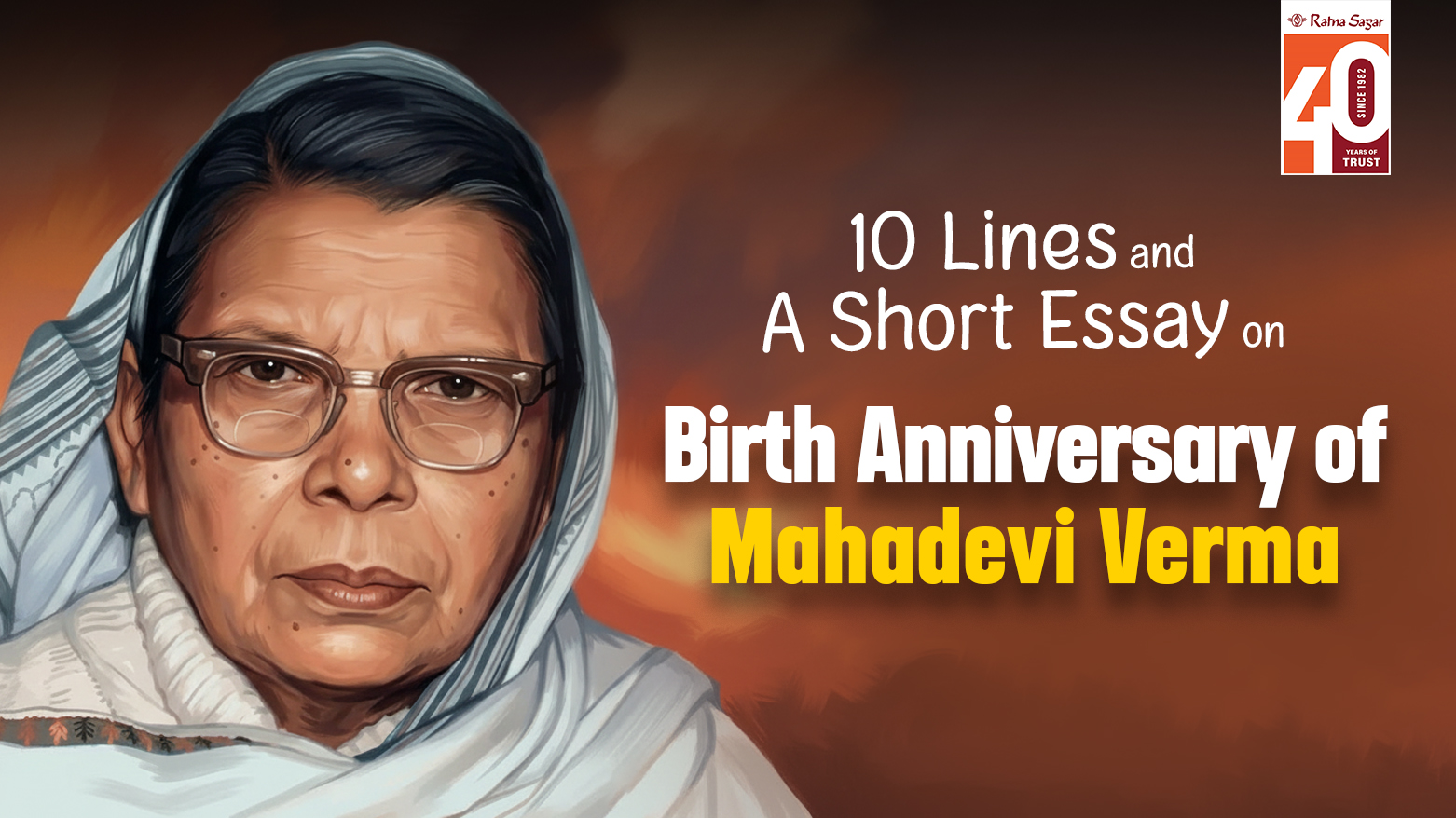
Birth Anniversary of Mahadevi Verma: Celebrating the Nightingale of Hindi Literature
Every year on March 26 India remembers one of its most celebrated literary figures — Mahadevi Verma. Known as the "Nightingale of Hindi Poetry" and the last great poet of the Chhayavad movement, she left behind a legacy that continues to touch hearts even today. Her birth anniversary is not just a date on a calendar. It is a moment to reflect on her extraordinary journey as a woman, a writer and a social reformer.
Whether you are a student looking for 10 lines on Mahadevi Verma or someone who wants to read a short essay on her birth anniversary you will find everything right here.
Who Was Mahadevi Verma?
Mahadevi Verma was born on March 26, 1907 in Farrukhabad Uttar Pradesh in a family that valued education and literature. From a very young age she showed a deep interest in poetry and writing. She went on to become one of the four pillars of the Chhayavad era in Hindi literature alongside Jaishankar Prasad Sumitranandan Pant and Suryakant Tripathi 'Nirala'.
What made her stand out was not just her poetry but also the courage she carried in her words. At a time when women were expected to stay quiet she chose to speak — loudly and beautifully.
10 Lines on Birth Anniversary of Mahadevi Verma
Here are 10 simple and meaningful lines that capture the essence of Mahadevi Verma and her birth anniversary:
- Mahadevi Verma was born on March 26, 1907 in Farrukhabad Uttar Pradesh.
- She is celebrated as one of the greatest poets of the Chhayavad movement in Hindi literature.
- Her birth anniversary is observed every year to honor her immense contribution to Indian literature.
- She is often called the "Nightingale of Hindi Poetry" for her lyrical and emotional writing style.
- Her famous works include Yama Neerja Sandhyageet and Deepshikha.
- She was a strong voice for women's rights and education during a time when very few dared to speak up.
- She was awarded the Padma Bhushan in 1956 and the Jnanpith Award in 1982 — India's highest literary honor.
- She also served as the Principal of Prayag Mahila Vidyapith and dedicated her life to women's education.
- Her prose writings like Ateet Ke Chalchitra and Smriti Ki Rekhayein are equally beloved and widely read.
- She passed away on September 11, 1987 but her words and ideals continue to inspire generations of readers and writers.
A Short Essay on Birth Anniversary of Mahadevi Verma
Introduction
The birth anniversary of Mahadevi Verma is celebrated with great respect and warmth across India especially in schools, colleges and literary gatherings. Born on March 26, 1907 she grew up to become not just a poet but a symbol of strength, sensitivity and social awareness. Every year on this day we remember the woman who turned pain into poetry and silence into a powerful voice.
Her Life and Journey
Mahadevi Verma grew up in a time when Indian society was going through enormous change. Women's education was rare and their voices were seldom heard in public spaces. But Mahadevi broke those boundaries early on. She pursued her education with determination and earned her Master's degree in Sanskrit from Allahabad University.
Her personal life was also unconventional. She married at a young age but chose to live independently, dedicating herself to her work and to the cause of women's upliftment. This quiet rebellion was visible in everything she did — from her writing to her lifestyle.
Her Literary Contributions
Mahadevi Verma's poetry is deeply rooted in emotion and spirituality. She wrote about longing for separation , nature and the inner world of a woman with a kind of tenderness that was entirely her own. Her poems were not just beautiful — they were honest. They spoke of feelings that many women experienced but rarely had the words to express.
Some of her most celebrated works include:
- Neerja (1934)
- Sandhyageet (1936)
- Yama (1936) — for which she received the Sahitya Akademi Award
- Deepshikha (1942)
- Ateet Ke Chalchitra and Smriti Ki Rekhayein (prose works)
Her writing had a quality that was rare — it could make you feel deeply moved without ever being dramatic. There was always a quiet dignity in her words.
Her Role as a Social Reformer
What many people may not know is that Mahadevi Verma was not just a literary figure. She was also a deeply committed social worker. She spent a significant part of her life working towards the education and empowerment of women. As the Principal of Prayag Mahila Vidyapith she shaped the lives of countless young women and encouraged them to dream bigger.
She also wrote extensively in prose about the struggles of ordinary people, especially women living on the margins of society. Her prose portraits of simple women — a servant, a widow, a beggar — showed a rare compassion and a sharp eye for social injustice.
Awards and Recognition
Her contributions were recognized with some of India's most prestigious awards:
- Sahitya Akademi Award for Yama
- Padma Bhushan in 1956
- Jnanpith Award in 1982 — the highest literary honor in India
- Padma Vibhushan in 1988 (posthumous)
These awards were not just personal achievements. They were a recognition of the fact that a woman's voice in literature mattered and deserved to be celebrated at the highest level.
Why Her Birth Anniversary Matters
Celebrating Mahadevi Verma's birth anniversary is more than just honoring a poet. It is a reminder that literature has the power to change lives. It is an opportunity for schools and families to introduce young readers to a voice that is deeply Indian, deeply human and deeply relevant even today.
For students her life is a lesson in perseverance. For women she is a role model of quiet courage. For lovers of Hindi literature she is simply irreplaceable.
On her birth anniversary literary events, readings and cultural programs are held across India. Her works are recited, her essays are discussed and her legacy is kept alive in classrooms and hearts alike.
Conclusion
Mahadevi Verma left this world on September 11, 1987 but the world she built through her words remains very much alive. Her poems continue to be read in schools and universities. Her prose continues to move readers. And her spirit — that spirit of a woman who refused to be silent — continues to inspire.
On her birth anniversary let us not just remember her with respect. Let us carry forward her belief that words have power and that speaking the truth — even when it is difficult — is one of the most important things a person can do.
Recent Posts
International Day of the Girl Child: 10 Lines & Essay
09/10/2026
R K Narayan Birth Anniversary: Malgudi, Books & Legacy
06/10/2026
Gandhi Jayanti: Truth, Non-Violence and Its Relevance Today
01/10/2026
Earth and Its Shapes: Facts for Kids | Classes 2–4
24/09/2026
International Sign Language Day: 10 Lines & Short Essay
18/09/2026
Engineer's Day: 10 Lines, Short Essay & Facts About Sir M. Visvesvaraya
14/09/2026