C. V. Raman Birth Anniversary: Celebrating India's Great Scientist and His Discoveries
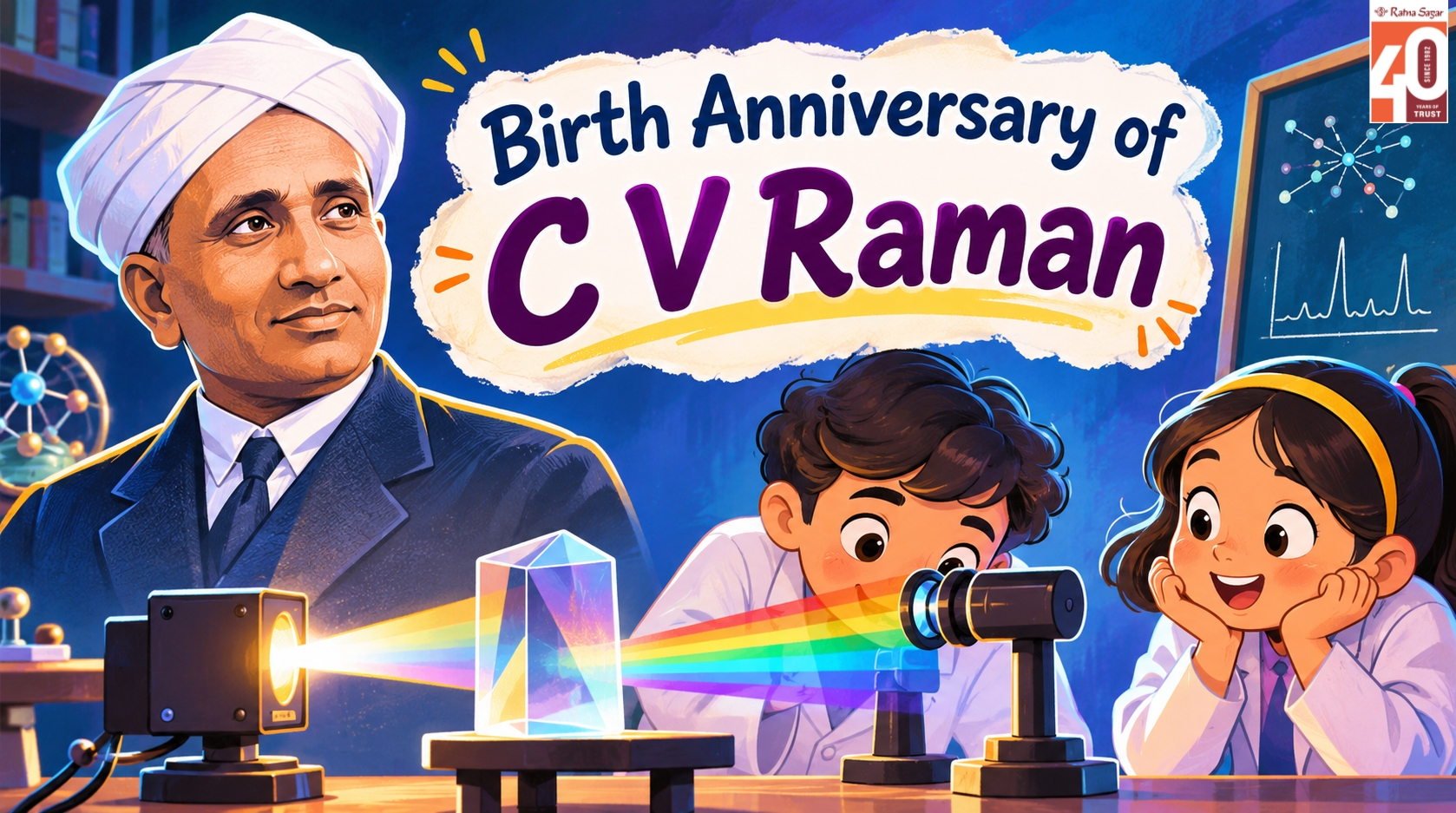
C. V. Raman Birth Anniversary: Celebrating India's Great Scientist
Have you ever wondered why the sky looks blue or how light creates different colours around us? These simple questions can lead to extraordinary scientific discoveries. One scientist who transformed his curiosity about light into a remarkable achievement was Sir Chandrasekhara Venkata Raman, popularly known as C. V. Raman.
Every year on 7 November, India celebrates the birth anniversary of C. V. Raman, one of the country's greatest scientists. His discovery of the Raman Effect earned him the Nobel Prize in Physics in 1930 and brought international recognition to Indian scientific research.
As we celebrate C. V. Raman's birthday, let us explore his inspiring journey, remarkable achievements and the lessons students can learn from his life.
Who Was C. V. Raman?
C. V. Raman was a renowned Indian physicist born on 7 November 1888 in Tiruchirappalli, Tamil Nadu. From childhood, he displayed an extraordinary interest in science and mathematics.
His father was a teacher of mathematics and physics, which helped Raman develop an early interest in scientific subjects.
He studied at Presidency College in Madras (now Chennai), completing his bachelor's degree in 1904 and master's degree in 1907 with outstanding academic results.
Although Raman initially worked in the Indian Finance Department, his passion for scientific research remained strong. He continued conducting experiments during his free time before eventually pursuing science as his full-time career.
His dedication made him one of the most famous Indian scientists in the history of science.
The Question That Sparked a Scientific Discovery
During a sea voyage in 1921, Raman became fascinated by the deep blue colour of the Mediterranean Sea.
He began questioning why seawater appeared blue and how sunlight interacted with different substances.
This curiosity encouraged him to investigate the behaviour of light more deeply.
After years of experiments, Raman and his research collaborators discovered a remarkable phenomenon on 28 February 1928, which became known as the Raman Effect.
His journey reminds students that scientific discoveries often begin with ordinary observations and interesting questions.
What Is the Raman Effect?
The Raman Effect explains what happens when light interacts with molecules in a substance.
When light passes through a transparent material, most of it scatters without changing its frequency. However, a very small portion of the scattered light changes its frequency because it exchanges energy with the molecules.
This phenomenon is called the Raman Effect.
Why Is the Raman Effect Important?
The discovery helped scientists understand the molecular structure and properties of different materials.
Today, a technique based on this principle, called Raman spectroscopy, has applications in several fields:
Medicine: Studying biological tissues and identifying chemical substances.
Chemistry: Understanding the molecular composition of materials.
Environmental Science: Detecting and analysing pollutants.
Material Science: Investigating crystals, minerals and other substances.
Pharmaceutical Research: Examining the chemical composition of medicines.
Raman's discovery continues to support scientific research around the world.
C. V. Raman and the Nobel Prize in Physics
In 1930, C. V. Raman received the Nobel Prize in Physics for his research on the scattering of light and the discovery of the Raman Effect.
He became the first Asian scientist to receive a Nobel Prize in a scientific discipline.
This achievement was a proud moment for India and demonstrated that groundbreaking scientific research could be conducted in the country.
Raman also received the Bharat Ratna in 1954, India's highest civilian honour, in recognition of his exceptional contributions to science.
Other Important Contributions to Science
Although Raman is best remembered for the Raman Effect, his scientific interests extended to several other subjects.
1. Study of Sound and Musical Instruments
Raman investigated how musical instruments such as the tabla, mridangam and violin produce sound.
His research helped explain vibrations and musical tones.
2. Research on Crystals and Minerals
He studied how light behaves when it passes through crystals, diamonds and other materials.
3. Advancement of Scientific Research in India
Raman helped establish the Indian Academy of Sciences in 1934 and founded the Raman Research Institute in Bengaluru in 1948.
These institutions contributed to the growth of scientific research and education in India.
Why Is National Science Day Celebrated in India?
Did you know that National Science Day in India is celebrated every year on 28 February?
This date marks the discovery of the Raman Effect in 1928.
While C. V. Raman's birth anniversary falls on 7 November, National Science Day commemorates his most celebrated scientific achievement.
Schools and educational institutions observe this occasion through science exhibitions, experiments, quizzes and educational activities.
The celebration encourages students to develop scientific thinking and appreciate the contributions of Indian scientists.
What Can Students Learn from C. V. Raman?
The C. V. Raman biography offers valuable lessons that extend beyond science textbooks.
Stay curious: Ask questions about everyday things. Curiosity is the beginning of discovery.
Keep experimenting: Scientific understanding develops through observation, testing and learning from results.
Follow your interests: Raman continued scientific research even while working in another profession.
Think independently: New discoveries often emerge when people explore familiar ideas from different perspectives.
Never stop learning: Raman continued studying scientific problems throughout his life.
These qualities make him one of India's most inspirational scientists.
Making Science Interesting with Ratna Sagar
C. V. Raman believed in exploring the world through observation and experimentation. His approach reminds us that science becomes more meaningful when students connect classroom concepts with everyday experiences.
At Ratna Sagar, science education encourages learners to explore, question and understand the world around them.
Educational resources such as the Living Science series include practical activities, experiments and opportunities for critical thinking.
Students can develop their scientific skills through simple activities such as observing the reflection of light, exploring shadows and investigating how different objects produce sound.
These experiences help transform theoretical knowledge into meaningful understanding.
Celebrating the Legacy of a Great Indian Scientist
The birth anniversary of C. V. Raman is an opportunity to remember a scientist whose curiosity, determination and groundbreaking discoveries changed our understanding of light.
His achievements continue to inspire young learners to explore science with confidence.
On this special occasion, students can honour his legacy by asking thoughtful questions, conducting experiments and discovering something new about the world.
Remember, every great scientific discovery begins with curiosity!
Explore more educational books and learning resources at www.ratnasagar.com and make your journey of scientific discovery exciting and meaningful.
Recent Posts
C. V. Raman Birth Anniversary: Celebrating India's Great Scientist and His Discoveries
05/11/2026
Unity in Diversity: India's Strength, Culture & Unity
03/11/2026
The Night Sky for Kids | Class 1 English Animated Story
26/10/2026
My Family Animated Story for Kids | Ratna Sagar
22/10/2026
Dussehra Across India: Traditions, Stories & 10 Lines and a Short Essay on Dusshera
15/10/2026
Did Mani Take a Bath? | Personal Hygiene for Kids
15/10/2026
Planning a Picnic: Class 1 English Learning
13/10/2026
International Day of the Girl Child: 10 Lines & Essay
09/10/2026Recommended Books