R K Narayan Birth Anniversary: Malgudi, Books & Legacy
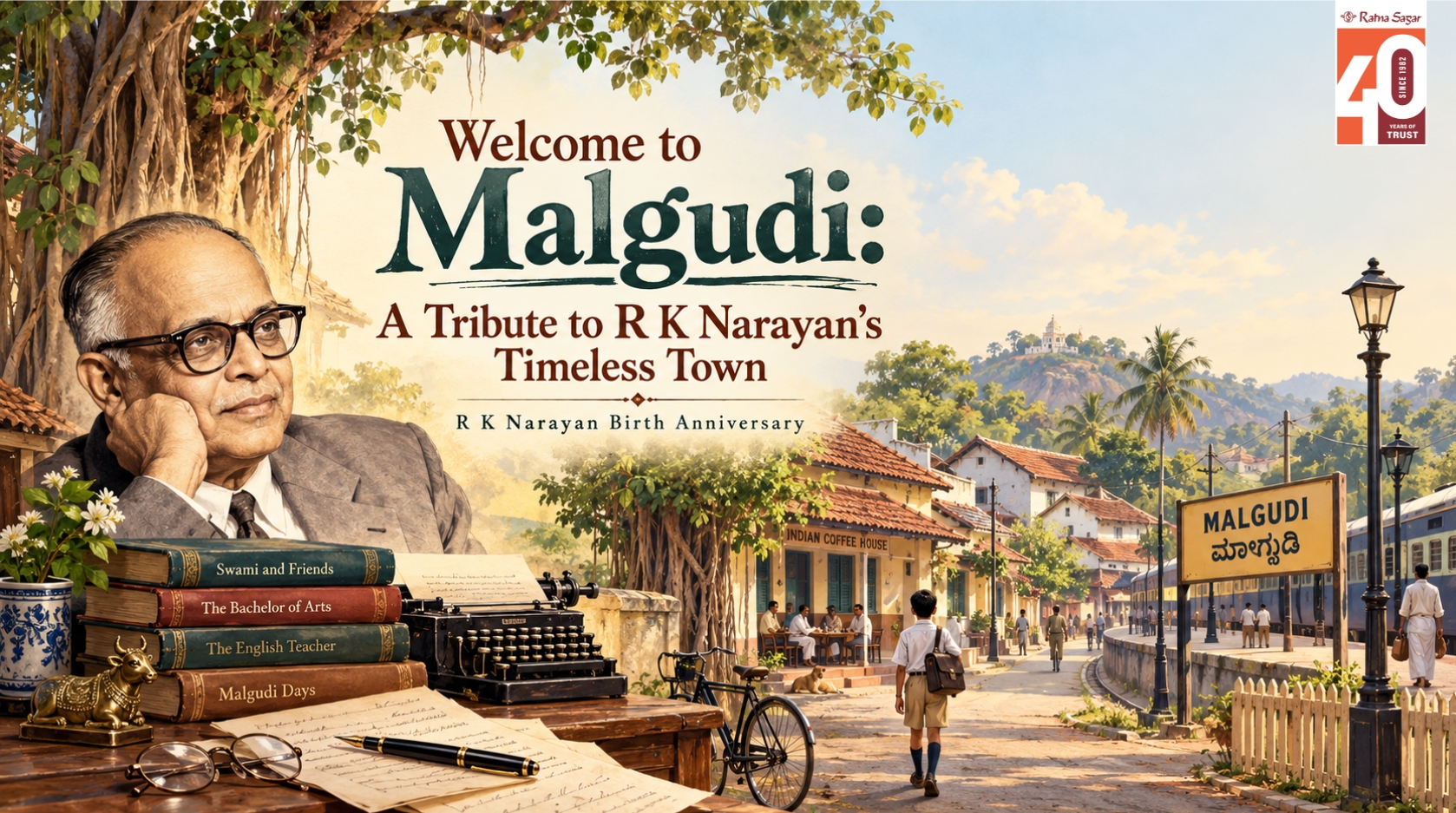
Welcome to Malgudi: A Tribute to R K Narayan's Timeless Town
There is a small town in South India that does not appear on any map, yet millions of readers know its streets by heart. It has a railway station, a river called Sarayu, a bustling market, a school, and a cast of characters who feel like neighbours. This is Malgudi, and its creator was R K Narayan, one of the finest storytellers in Indian writing in English.
Every year on 10 October, his birth anniversary gives readers, teachers, and students a reason to revisit his work. This blog looks at the man, his imaginary town, and why both still matter.
The Man Behind Malgudi
Rasipuram Krishnaswami Iyer Narayanaswami was born on 10 October 1906 in Madras (now Chennai). He grew up largely in the care of his grandmother and studied in Madras and Mysore. He is often known by his initials, and his younger brother R K Laxman became one of India's best-known cartoonists, famous for the "Common Man" in The Times of India.
Narayan's writing career did not start smoothly. His early manuscripts were rejected several times. The turning point came when the English novelist Graham Greene read his work and helped him find a publisher. The result was Swami and Friends (1935), the first novel set in Malgudi.
Narayan went on to write for more than six decades. He received the Sahitya Akademi Award in 1960 for The Guide, the Padma Bhushan in 1964, and the Padma Vibhushan in 2000. He was also nominated to the Rajya Sabha in 1989. He passed away on 13 May 2001, leaving behind a large body of novels, short stories, essays, and memoirs.
Malgudi: A Town That Never Existed and Always Did
Malgudi is a fictional town, but it feels real because Narayan filled it with the everyday details of small-town India: shopkeepers, schoolteachers, astrologers, priests, clerks, and mischievous children. Landmarks like the Albert Mission School, the railway station, and the banks of the Sarayu recur across his books.
Narayan's genius lay in how he treated ordinary life. He rarely wrote about grand events. Instead, he found drama and humour in a boy's fear of a schoolmaster, a man's ambitions gone slightly wrong, or a family quarrel over tradition. Malgudi also changes gently over time, as railways, new ideas, and modern habits arrive, so it becomes a record of India in transition.
Books and Stories Worth Reading
Here are some of the most loved works set in Malgudi:
Swami and Friends: A funny, affectionate story of a schoolboy and his friends, a natural starting point for young readers.
The Bachelor of Arts: A young man's struggles with love, ambition, and growing up.
The English Teacher: A moving, partly autobiographical novel about loss and healing.
The Guide: The story of Raju, a tourist guide who is mistaken for a holy man. It is widely considered his masterpiece and was adapted into a well-known film.
The Man-Eater of Malgudi: A comic and unsettling clash between a printer and a domineering taxidermist.
Malgudi Days: A collection of short stories, including the famous "An Astrologer's Day" and "A Horse and Two Goats".
His memoir, My Days (1974), offers a candid look at his own life and writing journey.
10 Lines and a Short Essay on R K Narayan's Birth Anniversary
Students often search for 10 lines and a short essay on R K Narayan's birth anniversary for school assignments, speeches, and literary club activities. Here is a ready reference.
10 Lines on R K Narayan
R K Narayan was born on 10 October 1906 in Madras, now Chennai.
His full name was Rasipuram Krishnaswami Iyer Narayanaswami.
He is one of the most celebrated Indian writers in English.
His first novel, Swami and Friends, was published in 1935.
He created the fictional South Indian town of Malgudi.
His famous works include The Guide, The English Teacher, and Malgudi Days.
He won the Sahitya Akademi Award in 1960 for The Guide.
He was awarded the Padma Bhushan and the Padma Vibhushan.
His brother, R K Laxman, was a famous cartoonist.
He passed away on 13 May 2001, but Malgudi lives on in readers' hearts.
Short Essay on R K Narayan's Birth Anniversary
R K Narayan was born on 10 October 1906 and became one of India's most loved storytellers. He gave readers the imaginary town of Malgudi, where simple people live ordinary lives full of humour, kindness, and small surprises. His writing is easy to read, gentle in tone, and deeply human. Novels like The Guide and stories like "An Astrologer's Day" show his skill in capturing the way people think and feel. His birth anniversary is a good time to read his books, discuss his characters, and appreciate how he made everyday India worthy of literature.
From Page to Screen
Malgudi reached an even wider audience through Malgudi Days, the television series directed by Shankar Nag and first aired in the 1980s. Its gentle storytelling and memorable title tune made it a favourite with families, and many people still remember it fondly. Watching an episode after reading the story is a fun way for students to compare how words become images.
Why Narayan Still Matters
In a world of fast content and loud opinions, Narayan's writing offers something rare: patience. His prose is clear, his humour is kind, and he trusts readers to notice small details. For young readers and learners of English, his sentences are an excellent model of simple, elegant writing.
His stories also carry quiet lessons. They show that ambition can be foolish, that tradition and change must learn to coexist, and that people are rarely wholly good or bad. They ask us to look at those around us with curiosity and warmth.
Conclusion
Malgudi may not exist on any map, but it exists wherever a reader opens one of Narayan's books. On his birth anniversary, the best tribute is simple: pick up a story, read it slowly, and enjoy the company of its characters. Whether you begin with Swami and Friends or "An Astrologer's Day", a warm welcome is waiting. Welcome to Malgudi.
Recent Posts
The Night Sky for Kids | Class 1 English Animated Story
26/10/2026
My Family Animated Story for Kids | Ratna Sagar
22/10/2026
Dussehra Across India: Traditions, Stories & 10 Lines and a Short Essay on Dusshera
15/10/2026
Did Mani Take a Bath? | Personal Hygiene for Kids
15/10/2026
Planning a Picnic: Class 1 English Learning
13/10/2026
International Day of the Girl Child: 10 Lines & Essay
09/10/2026
R K Narayan Birth Anniversary: Malgudi, Books & Legacy
06/10/2026
Gandhi Jayanti: Truth, Non-Violence and Its Relevance Today
01/10/2026Recommended Books