10 Lines and A Short Essay on Mahatma Gandhi

10 Lines and A Short Essay on Mahatma Gandhi
In the annals of history, few figures have left as profound a mark as Mahatma Gandhi. Born Mohandas Karamchand Gandhi, his philosophy of nonviolent resistance, or Satyagraha, became a beacon of hope and a powerful tool for social and political change. His life’s work was instrumental in securing India's independence from British rule, and his legacy continues to inspire movements for civil rights and freedom across the globe. This blog post will explore the key aspects of Gandhi’s life and principles, first through a concise summary and then a more detailed essay.
10 Lines on Mahatma Gandhi
- Mohandas Karamchand Gandhi was born on October 2, 1869, in Porbandar, India.
- He is known as the "Father of the Nation" in India, or Bapu.
- Gandhi was a lawyer who studied law in London and practiced in South Africa.
- It was in South Africa that he first developed his philosophy of nonviolent resistance, known as Satyagraha.
- He returned to India in 1915 and led the country's struggle for independence.
- Gandhi lived a simple life, promoting self-reliance and wearing a traditional hand-spun dhoti.
- He organized peaceful protests, including the famous Salt March of 1930, to challenge unjust British laws.
- His core principles were Ahimsa (non-violence) and Satyagraha (truth force).
- He tirelessly worked for the upliftment of the poor and the eradication of untouchability.
- His ideals of peace and non-violence have had a lasting impact on global leaders like Martin Luther King Jr. and Nelson Mandela.
More on Mahatma Gandhi's Enduring Legacy
Mahatma Gandhi was not just a political leader; he was a moral and spiritual figure who demonstrated the incredible power of peaceful resistance. His life was a testament to the belief that the strongest force in the world is not brute strength, but the unwavering commitment to truth and non-violence.
After his return to India from South Africa, Gandhi took charge of the Indian National Congress and transformed it from an elite body into a mass movement. He understood that to achieve true freedom, the movement needed to be inclusive, reaching every corner of the country and every class of society. His simple attire and austere lifestyle resonated with the masses, who saw in him a leader who truly understood their struggles.
The Salt March is perhaps the most iconic example of his genius. By leading thousands of Indians on a 240-mile walk to the Arabian Sea to make their own salt, he turned a simple commodity into a symbol of defiance against an unjust tax. This act of civil disobedience captured global attention and exposed the moral bankruptcy of British rule. It was a clear, peaceful, and powerful way to show that the people would no longer be victims of oppression.
Beyond the political struggle, Gandhi was a social reformer. He fought against the deep-seated caste system, which he called "untouchability," and championed the rights of the marginalized. He advocated for a self-sufficient India, promoting the use of locally made khadi cloth as a symbol of economic freedom and a means of providing livelihoods for rural communities. His vision was not just for a politically free India, but for a morally and socially just one.
Gandhi’s philosophy was built on the twin pillars of Ahimsa and Satyagraha. Ahimsa, or non-violence, was more than just the absence of physical violence; it was a profound respect for all life. Satyagraha, or "truth force," was the belief that truth, if held with conviction and love, would ultimately triumph over injustice. These principles were not just strategies for political gain; they were a way of life.
His influence extended far beyond India’s borders. Decades after his death, his methods were adopted by civil rights leaders around the world. Martin Luther King Jr. and Nelson Mandela both credited Gandhi as a major inspiration for their nonviolent struggles against racial discrimination and apartheid. In a world still grappling with conflict and division, Gandhi's message of peace and reconciliation remains as relevant as ever.
In conclusion, Mahatma Gandhi's legacy is a powerful reminder that real change does not always require force or aggression. It can be achieved through courage, conviction, and an unshakeable belief in the power of truth. His life continues to be a lesson for all of humanity on the path to a more peaceful and just world.
Recent Posts
R K Narayan Birth Anniversary: Malgudi, Books & Legacy
06/10/2026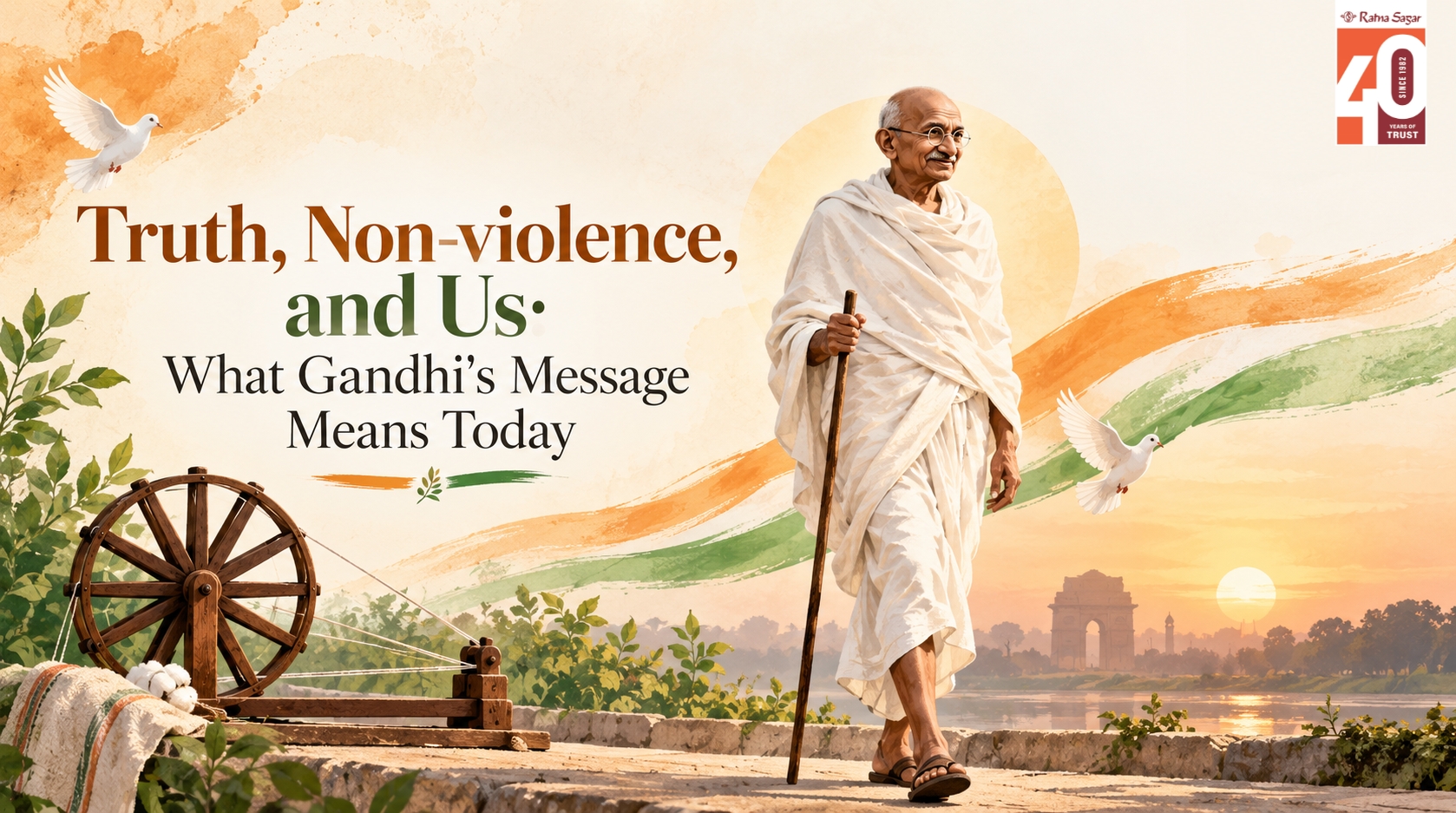
Gandhi Jayanti: Truth, Non-Violence and Its Relevance Today
01/10/2026
Earth and Its Shapes: Facts for Kids | Classes 2–4
24/09/2026
International Sign Language Day: 10 Lines & Short Essay
18/09/2026
Engineer's Day: 10 Lines, Short Essay & Facts About Sir M. Visvesvaraya
14/09/2026